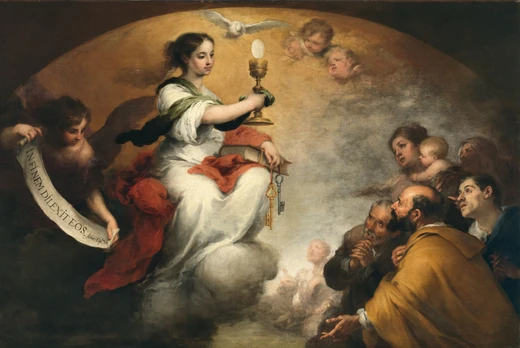
Thomas the Apostle
Apostle who doubted then confessed Jesus as Lord and God.

Wikipedia / Wikimedia Commons
Thomas the Apostle, also known as Didymus (both meaning 'twin'), was one of the Twelve Apostles of Jesus according to the New Testament. He is commonly called 'doubting Thomas' because he initially doubted the resurrection of Jesus until he saw and touched the wounds. He is regarded as the patron saint of India among Saint Thomas Christians, and his feast on July 3 is celebrated as Indian Christians' Day.
- known_for
- Doubting the resurrection of Jesus; evangelizing in India and Upper Mesopotamia
- field
- Apostle, missionary
- feast_days
- July 3 (Roman Catholic, many Anglicans); December 21 (traditionalist Catholics, Lutherans, some Anglicans); October 6 (Eastern Orthodox primary feast)
- patronage
- India (among Saint Thomas Christians)
- also_called
- Didymus, Judas Thomas
Lore & Background
Thomas first speaks in the Gospel of John when Lazarus has died, urging the apostles to go with Jesus: 'Let us also go, that we may die with him.' Later, when Jesus says he is going to prepare a heavenly home, Thomas asks, 'Lord, we know not whither thou goest; and how can we know the way?' His most famous episode is in John 20:24–29, where he refuses to believe the risen Jesus has appeared unless he sees and touches the nail prints and side. When Jesus appears and invites him to touch, Thomas exclaims, 'My Lord and my God.' Jesus replies, 'Thomas, because thou hast seen me, thou hast believed: blessed are they that have not seen, and yet have believed.'
According to early Christian tradition, Thomas is believed to have traveled to India, where he is honored as the founder of the Saint Thomas Christian community. Traditional accounts hold that he landed in the Chera Kingdom at Muziris in AD 52 and was martyred in Mylapore near Madras in AD 72, establishing seven churches in Kerala. However, the visit of St. Thomas is still a matter of dispute among historians. The Gospel of Thomas, a non-canonical text found at Nag Hammadi, begins: 'These are the secret sayings that the living Jesus spoke and Didymus, Judas Thomas, recorded.' Early Syrian traditions relate his full name as Judas Thomas. In the Book of Thomas the Contender, he is alleged to be a twin to Jesus.
Reader's Guide
Thomas the Apostle is significant primarily for his role in the Gospel of John as the doubter who becomes a confessor of faith, providing a narrative of skepticism overcome by direct encounter with the risen Christ. His story has given rise to the phrase 'doubting Thomas,' used for any skeptic who refuses to believe without personal experience. Beyond the New Testament, Thomas is central to the traditions of the Saint Thomas Christians in India, who trace their church's origins to his missionary work in the 1st century. He is also associated with the Church of the East in Upper Mesopotamia and with early churches in Sri Lanka and the Middle East. The feast of Saint Thomas is observed on multiple dates across denominations: July 3 in the modern Roman calendar and many Anglican calendars, December 21 in traditionalist Catholic and Lutheran calendars, and October 6 in the Eastern Orthodox Church. The name Thomas remains popular among Saint Thomas Christians in Kerala. His legacy endures as both a biblical figure embodying doubt and faith, and as a foundational evangelist for Christian communities in Asia.
Did You Know?
- Thomas is called 'Didymus' in Greek, both meaning 'twin'.
- In the Nag Hammadi Gospel of Thomas, he is called 'Didymus, Judas Thomas'.
- The phrase 'doubting Thomas' originates from John 20:24–29.
- Some early traditions identify Thomas as a twin of Jesus.
Gallery


Frequently Asked Questions
Who is Thomas the Apostle?
Thomas, also called Didymus (a word meaning 'twin'), was one of the twelve apostles chosen by Jesus in the New Testament. He is best remembered for his initial skepticism about the resurrection and his later bold confession of Christ's divinity.
Why is Thomas called 'doubting Thomas'?
After the crucifixion, Thomas refused to accept the other disciples' reports of the risen Christ until he could physically examine the wound marks. When Jesus appeared and invited him to do exactly that, Thomas declared him 'My Lord and my God,' and Jesus responded by blessing those who believe without seeing.
What was Thomas the Apostle's mission after the Ascension?
Tradition holds that Thomas traveled to Upper Mesopotamia and India to spread the Christian message. His work in India is particularly significant, as he is credited with establishing the Saint Thomas Christian community there.
What are Thomas the Apostle's feast days across different traditions?
Roman Catholics and many Anglicans commemorate him on July 3, while traditionalist Catholics, Lutherans, and some Anglicans observe December 21. The Eastern Orthodox Church marks his primary feast on October 6.
Why is Thomas the Apostle important to Indian Christians?
He is venerated as the patron saint of India among the Saint Thomas Christians, who trace their faith to his evangelization of the region. His July 3 feast day is celebrated as Indian Christians' Day in recognition of his foundational role in their tradition.
More in Christian Reformers And Mystics 1-23
Spotted an error? Know more?
This is a living reference — every entry is fact-audited, and reader corrections feed straight into our audit queue. Suggest an edit · See this site's audit record