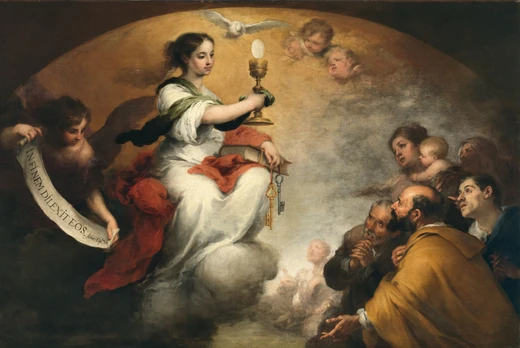
Simon the Zealot
Apostle of Jesus, known as the Zealot or Canaanite.

Wikipedia / Wikimedia Commons
Simon the Zealot, also known as Simon the Canaanite or Simon the Canaanean, was one of the twelve apostles of Jesus. He appears in all three Synoptic Gospels and the Book of Acts, where he is distinguished from Simon Peter by the epithet 'Zelotes' (Luke 6:15, Acts 1:13) or 'Kananites' (Matthew 10:4, Mark 3:18). The name likely derives from the Hebrew word for 'zealous,' leading most scholars to associate him with the Zealot movement, though some early interpreters, such as Jerome and Bede, suggested he came from Cana in Galilee.
- also known as
- Simon the Canaanite, Simon the Canaanean
- role
- Apostle of Jesus
- mentioned in
- Matthew 10:4, Mark 3:18, Luke 6:15, Acts 1:13
- epithet meaning
- Zealous (from Hebrew qanai); possibly from Cana in Galilee
- associated traditions
- Evangelized in Egypt, Africa, Mauretania, Libya, Persia, Armenia, Britain; martyred by crucifixion, sawing, or peacefully
Lore & Background
Simon the Zealot is named in all lists of the apostles in the Synoptic Gospels and Acts, always with a distinguishing epithet. In Luke and Acts he is called 'Zelotes,' while in Matthew and Mark he is called 'Kananites' or 'Kananaios,' terms that most scholars today translate as 'Zealot.' However, Jerome and Bede argued these terms meant 'Canaanean' or 'Canaanite,' suggesting Simon came from Cana in Galilee. The New Testament records nothing more of Simon beyond these mentions, though later traditions and apocryphal writings supply various details.
Reader's Guide
Simon the Zealot's significance lies primarily in his inclusion among the twelve apostles and the enduring ambiguity of his epithet. The term 'Zealot' may connect him to a Jewish political movement that opposed Roman rule, though some scholars argue the Zealot party did not emerge until decades after the Gospel events, and that the word simply meant 'zealous' for the Law. This uncertainty reflects broader debates about the historical context of the apostles and the early Christian community. Simon's sparse New Testament presence contrasts with a wealth of later traditions—some contradictory—that assign him missionary journeys across Africa, Asia, and Europe, and various forms of martyrdom. These traditions, while historically unverifiable, illustrate how early and medieval Christians filled gaps in the apostolic record with edifying narratives. Simon's shared feast day with Jude the Apostle (28 October in Western Christianity) and his attribute of a saw in Christian art underscore his role as a model of zeal and sacrifice. In Islam, Muslim exegesis includes him among the disciples sent to the Berbers. Overall, Simon the Zealot exemplifies how a figure with minimal biblical data can become a canvas for diverse cultural and theological interpretations.
Did You Know?
- Simon is called 'Zelotes' in Luke and Acts, but 'Kananites' or 'Kananaios' in Matthew and Mark, both terms deriving from the Hebrew word for 'zealous.'
- Jerome and Bede suggested Simon's epithet meant he was from Cana in Galilee, not that he was a Zealot.
- The apocryphal Arabic Infancy Gospel claims Jesus healed a boy named Simon from a snakebite and told him he would become a disciple, identifying him as Simon the Cananite.
- In Christian art, Simon is often depicted with a saw, reflecting a tradition that he was martyred by being sawn in half.
More in Christian Reformers And Mystics 1-23
Spotted an error? Know more?
This is a living reference — every entry is fact-audited, and reader corrections feed straight into our audit queue. Suggest an edit · See this site's audit record